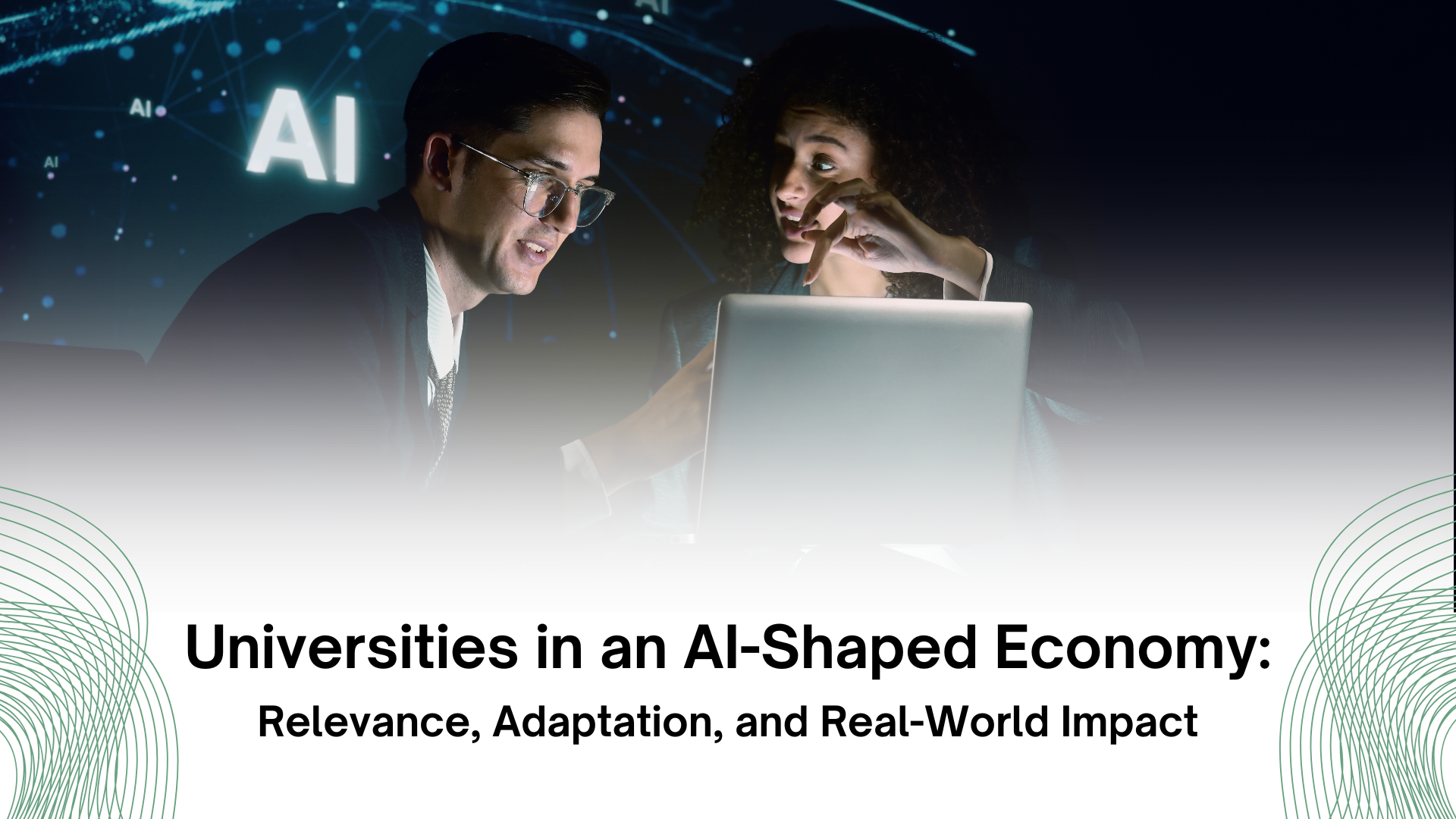


In an AI-shaped economy, do universities still hold value to the next generation?
The short answer is yes, but not in the same way they did before.
In today’s rapidly evolving environment, the role of universities is shifting dramatically.
The old model, where a degree was a guaranteed ticket to a career, is giving way to a new reality where what truly matters is how effectively individuals can learn, adapt, and collaborate with both humans and machines.
Employer demand for AI and technical expertise has increased significantly over the last decade, but equally important are human capabilities like adaptability, resilience, and collaboration. These signal a fundamental shift in what effective contribution looks like.
Universities continue to hold value, but only when they connect learning directly to application. This means moving beyond traditional lectures and exams to embed authentic experiences within their programmes:
- Business students engaging in 12-week consulting projects with real clients
- Engineering students spending significant portions of their studies in co-op placements on live job sites
- Technology graduates earning industry-recognised certifications in AI and cloud computing, validated by employers
- Capstone projects that culminate in portfolios of delivered work, not just theoretical papers
When universities integrate these elements, they become powerful launchpads for individuals who can contribute meaningfully from early in their careers.

At the same time, a growing number of young people are choosing alternative paths. Many delay or skip university to gain hands-on experience faster by joining startups or launching their own ventures. This approach offers exposure, autonomy, and breadth from day one, building portfolios that demonstrate capability more effectively than transcripts.
However, this path carries risks: early-career earnings can be lower, support structures are often weaker, and success depends heavily on external factors like leadership quality, business viability, and mentorship availability.
The core challenge today is the ability to deliver value immediately, not someday, but from day one. The half-life of expertise has shrunk to 12–18 months, meaning continuous learning and rapid adaptation are essential.
To operate effectively in this landscape, organisations and institutions must rethink how learning is structured, applied, and evolved over time. AI fluency must be embedded across roles, and mentorship and relevant experience should be prioritised early in career journeys.
This is no longer a simple pipeline from education to employment. It’s a dynamic cycle of learning, applying, and evolving, at the pace of change.
The question for leaders, educators, employers, and families is:
How will we design systems that enable people to contribute meaningfully, early, and continuously?
What would have made your own transition into work more effective, deeper mentorship, real-world application, or earlier exposure to complex problem-solving?
The answers to these questions will shape how we build individuals who can navigate and contribute in an increasingly complex world.